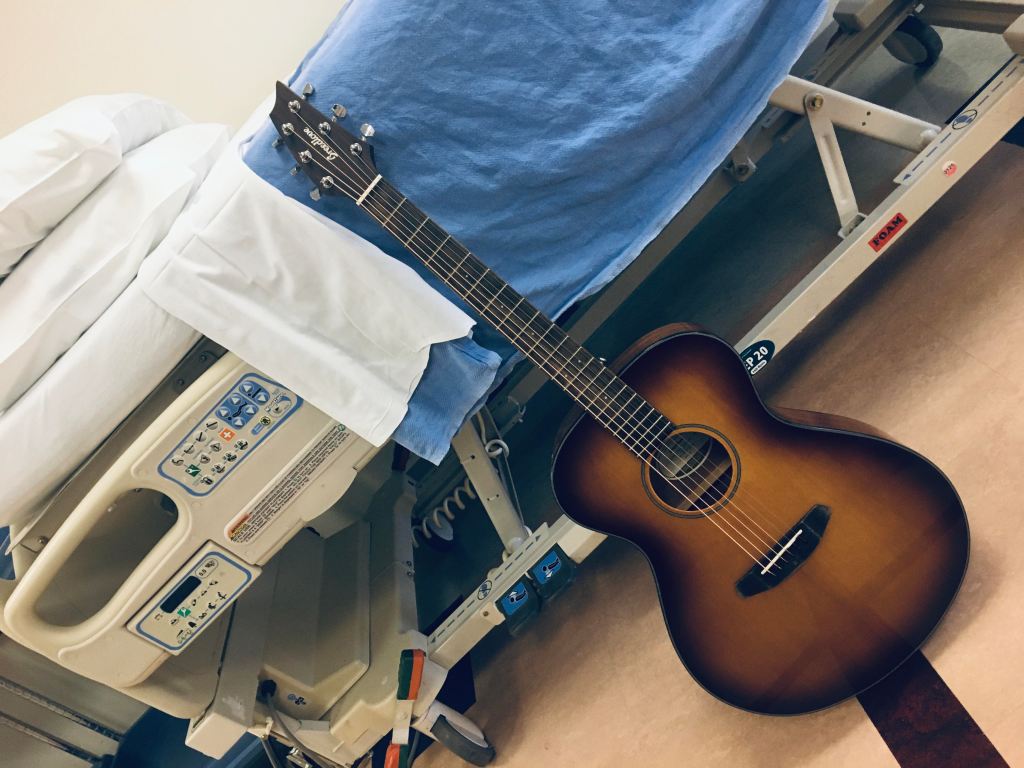
One of the great things about my job as a music therapist working in a hospital setting is that I learn something on an almost daily basis. And I learn all of these things from the people that I share music with, people who are working through unbelievable challenges, both physically and mentally. Sometimes I just feel as though I’m on some sort of ride, or I’m a conduit of providing music to help as needed in the moment. Here are some of the things that I’ve learned that have truly affected me:
Music Creates Connection and Intimacy
On a daily basis this idea simply amazes me. It amazes me that I can walk into a hospital room, meet someone for the very first time, and then soon, as music is shared, feel such a connection to them. And it becomes very intimate. It’s hard to explain. There is emotion. There is release. And intimate stories and feelings are shared. All as a result of sharing music together.
I took out the guitar… and I played. What did I play? How did I know what to play? Well… that’s not easy to put into words. I played what I felt she may be feeling inside infused with something soothing, like a musical ‘blanket’, or, more like ‘holding’ her with the music. I responded, with music, to what I was ‘getting back’ from her. What I felt, organically in the moment. I was not trying to ‘cheer her up’. I was not trying to ‘make things better’, I was just being present with her within the music. And… it was so intimate.
Music Creates Connection Between People
So many times, I walk into a hospital room and the visitors/family members are sitting in various spots, or in corners, and are sometimes seemingly distracted. Sometimes distracted in their own thoughts and reflections, sometimes on their phones. And I know that a lot of that has to do with coping with the situation. But, almost like someone hitting a switch, when music is introduced, they come together. They connect. They connect with the patient, and they connect with each other. And they connect with the music.
She’s in her 90s and recently moved to ‘hospice’ care. Her eyes were closed, and she was mainly non-respondent, but seemed comfortable. Her family was there, her adult daughter and her grandson and his girlfriend. When I walked in, the room was quiet. Everyone seemed to be in their own little world, as if waiting for… I offered some music, for comfort. “Sure” her daughter said, and I took out my guitar and played a little. Then I transitioned into an easy version of ‘Somewhere Over the Rainbow’. And then… all three moved to the bed. And then… they took her hands. And then… they all joined in singing. And in beautiful harmony! The patient suddenly opened her eyes and looked lovingly into her grandson’s gaze as he sang to her. A incredible smile overtook her face… and his too, through his tears. It was such a profound and beautiful moment. One that I don’t think they will ever forget. (And neither will I.) All because of… music.
Music Truly is the Universal Language
In the hospital, there are many languages. And sometimes that can be a barrier in the healing process. But I am lucky. I have music. Yes, music is the universal language. Especially when you are alone, sick, afraid, unsure…
“He speaks no English so we can’t really talk with him. And he’s had no visitors,” the nurse told me when she asked me to visit with him. He’d already been isolated in the hospital for some time receiving cancer treatment. I walked into his dark room, and it was so quiet I could hear the IV drip. He looked at me and I showed him the guitar and gesturing to a chair as if to ask, “May I sit?” He tentatively shook his head “yes”. He was in bed with the covers pulled up and looked weak, so I just started playing something soothing, offering some music for comfort. He was looking straight up but seemed to be listening. After a few moments though, I noticed his left foot slowly moving. I kept the rhythm solid. And then, some movement in his head. I followed him with the music, adding a little more straight structure. Gradually, his eyes opened fully and slowly his body seemed to… activate? He transformed—and the music followed. More rhythm. More intensity. More movement. And soon, it felt as though we were… grooving? He looked at me and his smile lit up the gloomy room. It became a music and movement improvised jam-session. And the movement in his body seemed to give him some energy. Some life. I eventually worked my way to ‘One Love’ without even thinking about it and starting singing. He pointed at me, laughed, and said “Ahhh…” Of course he knew Bob Marley! He took it in. He felt the music. He could not stop smiling. No words were spoken for the half hour I was there. There was no need. We had music. And then, as I was waving goodbye and about to walk out—three words… “Come back again.”
Music Brings Hope Even in a Place Where Hope Seems Hard to Find
Music can help in so many ways, including reducing anxiety and pain, helping with coping with a new diagnosis or treatment, as a means of emotional outlet. But simply the best thing that music can provide, in my opinion, when someone is hurting, feeling the challenges of all the pain, is… hope.
“What is that song about?” I asked the group, at an in-patient behavioral health facility where I was facilitating a music therapy session, after listening to ‘Don’t Stop’ (Fleetwood Mac.) There was silence. Many looking down with flat, tired faces. No eye contact between anyone. But then, a quiet voice from a young woman sitting to the side, “Maybe that things will be different tomorrow? Maybe better? Maybe it won’t be the same as it was before?” Then, with tears in her eyes she looked up, – “The song is about hope.” I played the song again and one of the older women, who was sitting on the other side of the room, got up, walked over to her and took her hand… and they started to dance. Soon the flat, tired faces showed some smiles. And soon… more got up to dance. One of the nurses joined in. Suddenly there was laughter, connection, and some sense of joy in a mostly joyless place. And… a feeling of hope filled the room. Music for reflection. Music for empowerment. Music to create hope for a better tomorrow.
The Power of a Smile
Music therapy in the hospital is not going to ‘fix’ things. It’s not going to take away cancer and it’s not going to suddenly restore full brain activity after a stroke. It’s not magic. But music can give ‘something’… something different and something needed on another level. On a humanistic and spiritual level.
“You made her smile!” her son said as I was playing and singing some of her favorite classic rock songs. Three months prior, although fairly young, she had a massive stroke and her road to recovery has been challenging. Her body is weak, and she’s been minimally responsive. But today… she smiled. And when she did, her son’s face lit up, “I haven’t seen you smile in so long mom!” And he smiled too (through the tears) as he took her hand. And then… his eyes lit up as he pointed to her feet, which were pulsating to the beat of Tom Petty’s ‘The Waiting’. (I mean, how can you not move your feet to a favorite T.P. song?) It’s been a long road, but today… a smile. A connection. A connection to the music and to her memories. And a connection to the rhythms of her body. And a start? Perhaps. The start of reconnecting with herself. And most importantly, a shared moment, and a smile, with her son. When I finished, she reached for my hand and as I took it, she squeezed hard and tried to speak. No words yet… but a smile.
When There is Nothing Left, We Still Have Music
Some of the most profound work for me in the hospital is working with patients at the end of life; providing music and comfort for them, and their families, as they are about to ‘transition’ to what comes next after this life. There is a lot of sadness and reflection, but there is also a sense of resolve, contentedness and, even joy in its own way. There are tears, smiles, sorrow, and celebration. Sometimes all at the same time. One of the most powerful moments for me happened a few years ago when someone said to me, after providing music for their mother during her final moments, “You realize, that is the last music she will ever hear.” I will never forget that, and the feeling that came over me when he said it. But also powerful is, again, the connections that are created between the person ‘leaving’ and the person saying “goodbye”.
When I walked into the quiet room, his adult daughter was sitting next to the bed holding his hand. She didn’t hear me come in, so I gently said, “Hello.” She looked up and gave a slight smile through pensive eyes. He was mainly non-respondent at this point, but seemingly comfortable—and very near the end. She was holding vigil. I offered some music, for comfort (thinking for both of them.) She again gave a slight smile and returned her gaze back to him. I started slowly on the guitar with a little ‘soundscape’ and soon started cycling through some structured songs, adding some humming into soft singing. I landed on a ‘lullaby’ version of ‘Can’t Help Falling in Love’. As I started to sing, she snapped her head around and looked right at me with wide eyes, startling me enough to stop. A few tears glistened on her face. After a pause she said, “That song… He used to sing me to sleep to that song when I was a little girl.” Another pause… I caught my breath… and then I said, “Should I continue?” A little nod “yes”. She was still holding my eye contact but seemed a little unsure. So I asked, “Would you like to sing along?” Her voice was sweet, soft, and comforting. After a verse, I backed out vocally and became her accompanist as she looked at him and sang as she held his hand. It was now her turn to sing him to sleep.
The healing power of music…
(*The stories presented in this blog are based on accounts or experiences and are not actual accounts or experiences.)
Raymond Leone, MMT, MT-BC is a board-certified music therapist based in Northern Virginia and writes extensively on music and wellness
 RaymondLeoneMusic
Leave a comment